

Migrating Fixed Assets Cleanly: Depreciation, Legacy Assets and the Asset Register
The half-depreciated machine is where most accounting migrations go wrong. How fixed assets, legacy holdings and depreciation land correctly in Saldio.

Contents
An unmatched payment gets noticed immediately. A wrong VAT code shows up at the latest when you file the return.
A forgotten depreciation entry only surfaces at year-end closing — and then retroactively across three years.
Fixed assets are the part of accounting that breaks most quietly. There is no daily contact with them, no document sitting in the inbox as a reminder. There is only a machine in the workshop that has carried the same value on the balance sheet for four years, because nobody ever updated the asset register.
This article shows how fixed assets are managed in Saldio — and above all, how existing, partially depreciated assets arrive correctly when you switch systems. That is exactly where most migrations fail.
Why fixed assets need their own subledger
Under CO Art. 960a, assets must be measured at acquisition cost on initial recognition and subsequently adjusted for depreciation caused by use and age. For a fixed asset that means: acquisition cost, useful life, accumulated depreciation, book value — per item, not as a lump sum.
The general ledger cannot deliver that. Account 1500 shows CHF 84,000 at year-end — but not whether that is one machine or seven, which of them was bought in 2021, and which will be fully depreciated next year.
That is what the fixed asset subledger is for. It holds the measurement parameters per asset, derives the depreciation schedule from them, and produces the asset register — the evidence auditors and tax authorities want to see.
In Saldio this subledger is deliberately narrow: it stores only the parameters. Every value-relevant movement — acquisition, depreciation, disposal — is a real journal entry in the general ledger. Book value, status and accumulated depreciation are derived from those entries and never stored separately. That sounds like a detail, but it has a practical consequence: reversing a journal entry corrects the fixed asset subledger automatically. There is no state in which subledger and general ledger can drift apart.
The migration: that half-depreciated machine
This is where the real trap sits.
Anyone switching to new accounting software today rarely starts with an empty asset register. There is a CNC mill from 2024, a delivery van from 2022, three laptops from last year. All partially depreciated, all with a remaining book value, all with a remaining useful life.
The obvious — and wrong — reflex is to enter today’s book value as the acquisition cost. That works for exactly one year and destroys the entire depreciation logic afterwards: the remaining life is wrong, the straight-line rate is wrong, and the asset register loses the acquisition history the tax authority wants to see.
The correct approach
In Saldio you record the asset with its historical values:
- Acquisition date — the actual purchase date, not the date you switched systems
- Acquisition cost — the actual historical cost, net of recoverable input VAT
- Already depreciated (CHF) — accumulated depreciation from prior years, straight from the last closing
- Method and useful life — unchanged from how the asset was managed before
What Saldio derives on its own is the key simplification: there is no field for “months already used” and no separate start date. The system calculates the gap between the acquisition date and the first fiscal year managed in Saldio, and treats those months as consumed.
An example
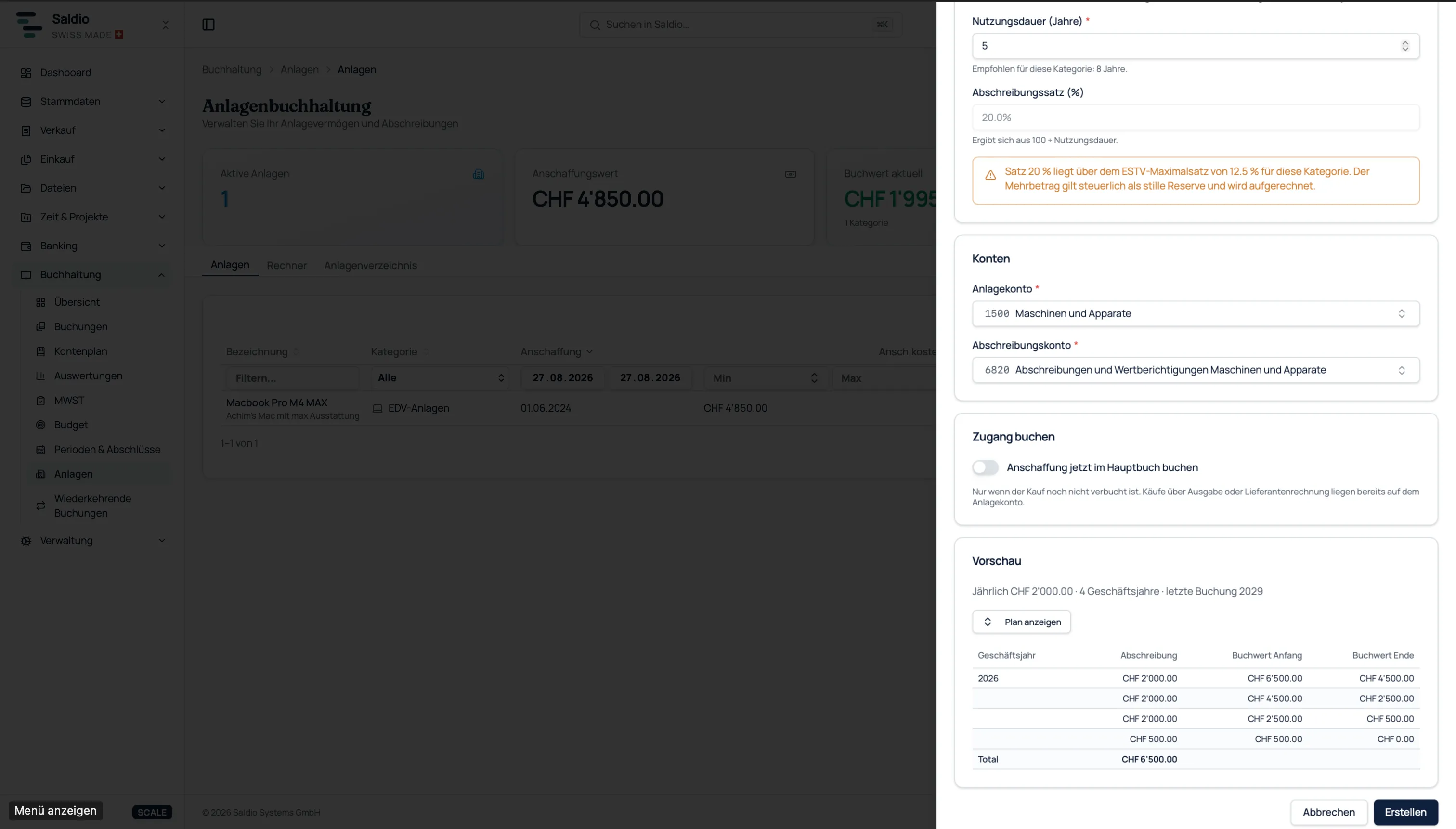
A machine costing CHF 10,000, purchased on 1 April 2024, straight-line over 5 years, no residual value. CHF 3,500 was depreciated through the end of 2025. Saldio is introduced with fiscal year 2026.
You record: acquisition 01.04.2024, cost 10,000, already depreciated 3,500, straight-line, 5 years.
Saldio recognises that 21 months (April 2024 through December 2025) are consumed, the opening book value is CHF 6,500, and 39 months of useful life remain. That produces this schedule:
| Fiscal year | Months | Depreciation | Book value start | Book value end | Type |
|---|---|---|---|---|---|
| 2026 | 12 | 2,000.00 | 6,500.00 | 4,500.00 | Annual depreciation |
| 2027 | 12 | 2,000.00 | 4,500.00 | 2,500.00 | Annual depreciation |
| 2028 | 12 | 2,000.00 | 2,500.00 | 500.00 | Annual depreciation |
| 2029 | 3 | 500.00 | 500.00 | 0.00 | Final entry |
The schedule picks up exactly where the old asset register left off — and runs cleanly down to zero with a three-month final entry. No rounding drift, no lost year.
Methods and the FTA rates
Saldio supports three depreciation methods:
Straight-line — a constant amount over the useful life: (acquisition cost − residual value) ÷ useful life. The rate follows from 100 ÷ useful life and is not entered separately.
Declining balance — a percentage of the current book value. Amounts shrink from year to year. Once the useful life has elapsed, the remaining book value is written down to the residual value with a final entry, so the series does not run towards zero forever.
Immediate write-off — 100 % in the year of acquisition, no pro rata. For low-value items; in practice CHF 1,000 serves as the threshold. Saldio actively points out that this route is permissible and simpler whenever acquisition cost falls below CHF 1,000.
An asset’s category drives the defaults — accounts, useful life, and the maximum rates from the FTA leaflet A 1995:
| Category | Asset account | Expense account | Max. straight-line | Max. declining | Useful life |
|---|---|---|---|---|---|
| Machinery and equipment | 1500 | 6820 | 12.5 % | 25 % | 8 years |
| Furniture and fixtures | 1510 | 6821 | 12.5 % | 25 % | 8 years |
| IT equipment | 1520 | 6822 | 20 % | 40 % | 5 years |
| Vehicles | 1530 | 6823 | 20 % | 40 % | 5 years |
| Real estate | 1600 | 6830 | 2 % | 4 % | 50 years |
| Intangible assets | free | free | 20 % | 40 % | 5 years |
These rates are a warning, not a hard stop. If you want to depreciate faster, you can — Saldio points out that the excess counts as a hidden reserve for tax purposes and will be added back, then posts anyway. Cantonal practice varies regardless, and the responsibility sits with the company, not the software.
Pro rata is calculated to the month. The acquisition month and the disposal month both count in full. A machine bought on 15 September depreciates four months in its acquisition year. Short fiscal years — a first fiscal year running 1 July to 31 December, say — are handled proportionally by the same logic.
The depreciation run
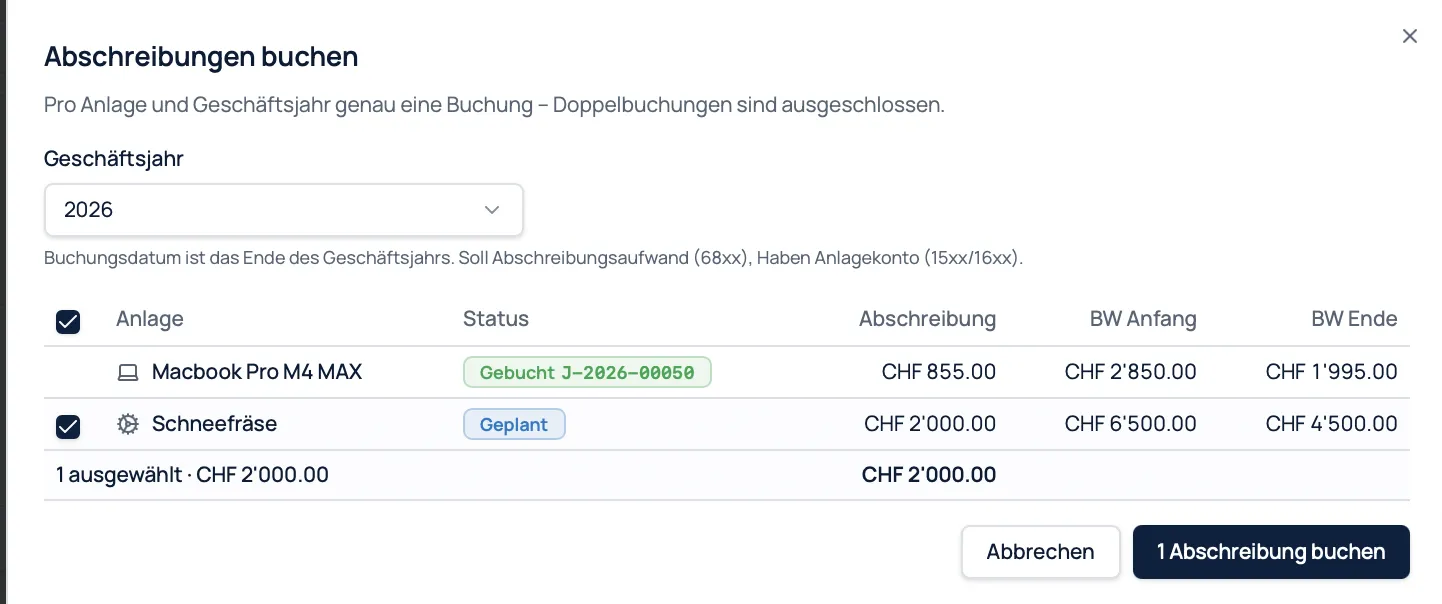
Depreciation in Saldio does not happen in the background. There is no nightly job posting entries silently. The depreciation run is triggered deliberately, per fiscal year.
In the dialog you pick the fiscal year, see the amount due for each asset along with the book value before and after, tick what should be posted — and post.
The entry is always the same:
| Debit | Credit | |
|---|---|---|
| Depreciation | Depreciation expense (68xx) | Asset account (15xx / 16xx) |
This is direct depreciation: the asset account is reduced immediately. Saldio deliberately does not maintain valuation allowance accounts (15x9) — for Swiss SMEs the direct method is the common one and sufficient for the tax balance sheet.
The posting date is always the end of the fiscal year, regardless of when the run is executed. Posting 2026 depreciation in March 2027 still lands in the journal as of 31.12.2026.
Three properties make the run robust in daily use:
Exactly one entry per asset and fiscal year. This is not just an application check but a database-level guarantee. A second click on “Post” cannot create a duplicate entry — not even with two browser windows open at once.
Skipped years are caught up. If an already-closed fiscal year was forgotten, Saldio folds it into the next run — with its own history line for each target year, so the asset register of prior years stays correct.
An open prior year blocks. If an earlier fiscal year is still open and undepreciated, Saldio refuses the run for the later year. That is intentional: otherwise the prior year’s expense would land in the current year and be irretrievably lost to the prior-year accounts.
What the calculator shows in the preview is exactly what gets posted. Preview and posting share the same calculation — there is no second implementation that could diverge.
Disposal: sale or scrapping
Eventually an asset leaves. Sold, traded in or scrapped — in accounting terms it is the same transaction with a different amount of proceeds.
Saldio posts the disposal in two steps. First it depreciates pro rata up to the disposal month, so the remaining book value at the disposal date is correct. Then follows the disposal entry using the gross method:
| Debit | Credit | |
|---|---|---|
| Proceeds | Bank / cash / receivable | Revenue account 8510 |
| VAT | 2200 | |
| Remaining book value | Expense account 8500 | Asset account |
The gain or loss on disposal is not posted as a separate line; it emerges as the difference between proceeds and remaining book value. The preview in the dialog calculates it before posting and shows it in green or red.
Two cases from practice:
Scrapping is a disposal with proceeds of 0. If the asset is already fully depreciated, no journal entry is created at all — there is nothing left to write off. The asset is simply marked as disposed.
Sale via an invoice. If the sale was already recorded as an outgoing invoice, the disposal entry would recognise the proceeds a second time. The dialog offers a “Proceeds already posted” switch for this — then only the remaining book value is written off.
Like the depreciation run, disposal requires earlier fiscal years to be depreciated. Otherwise their expense would migrate into the disposal year as a disposal loss.
The asset register
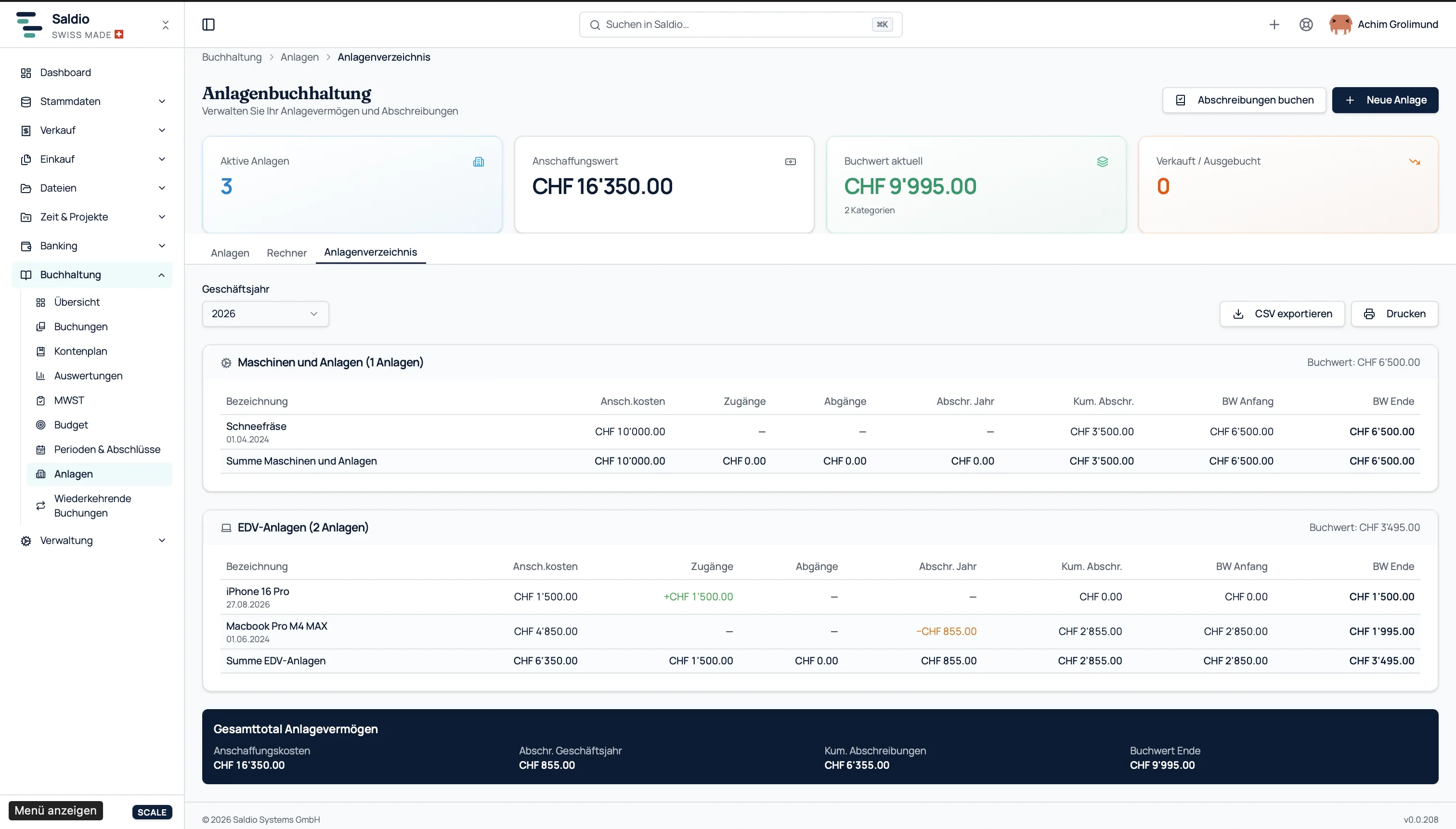
At year-end you need evidence. In Saldio that is the asset register, grouped by category — machinery, vehicles, IT equipment, furniture, real estate, intangibles — with a subtotal per group and a grand total at the bottom.
Each asset carries the classic columns: acquisition cost, additions, disposals, depreciation for the fiscal year, accumulated depreciation, and book value at the start and end of the period.
One detail that matters during migration: legacy depreciation flows correctly into accumulated depreciation and therefore into the opening book value. The asset register of the first Saldio fiscal year can be reconciled directly against the last register from the old system — opening book value has to match to the franc.
Accumulation follows the fiscal year of the history line, not the posting date. A 2026 depreciation caught up in March 2027 appears in the 2026 asset register, where it economically belongs.
The register exports as CSV; for the auditor’s binder there is a dedicated print view with company name, fiscal year and date range in the header.
What Saldio deliberately leaves out
Completeness is not an end in itself. A few things are missing on purpose, and it is fairer to name them:
- No valuation allowance accounts. Direct depreciation only; the asset account is reduced immediately.
- No bulk import. Legacy assets are entered one by one. With twelve assets that is an hour of work; with two hundred it would be a topic — get in touch in that case.
- Annual run, not monthly. For Swiss SME practice, year-end closing is the relevant cadence. Monthly accruals are not supported.
- No PDF export. CSV and print view — both are enough for audit and filing; a dedicated PDF renderer would be effort without benefit.
- No write-ups, no partial disposals, no subsequent acquisition costs. If you extend a machine, record the extension as its own asset.
Conclusion
Fixed asset accounting is not daily work. It is a setup done right once, and one click per fiscal year afterwards.
The entire effort sits in the migration — and so does the risk. Enter today’s book value as the acquisition cost and you have no error for a year, then one nobody can find. Enter the historical values plus accumulated depreciation and you get a schedule that connects seamlessly to where the old asset register stopped.
The rest — pro rata calculation, journal entries, catching up forgotten years, the asset register — takes care of itself.
From order to balance.